
Labor of Love
Teri Saylor
Special to Publishers' Auxiliary
Oct 1, 2026


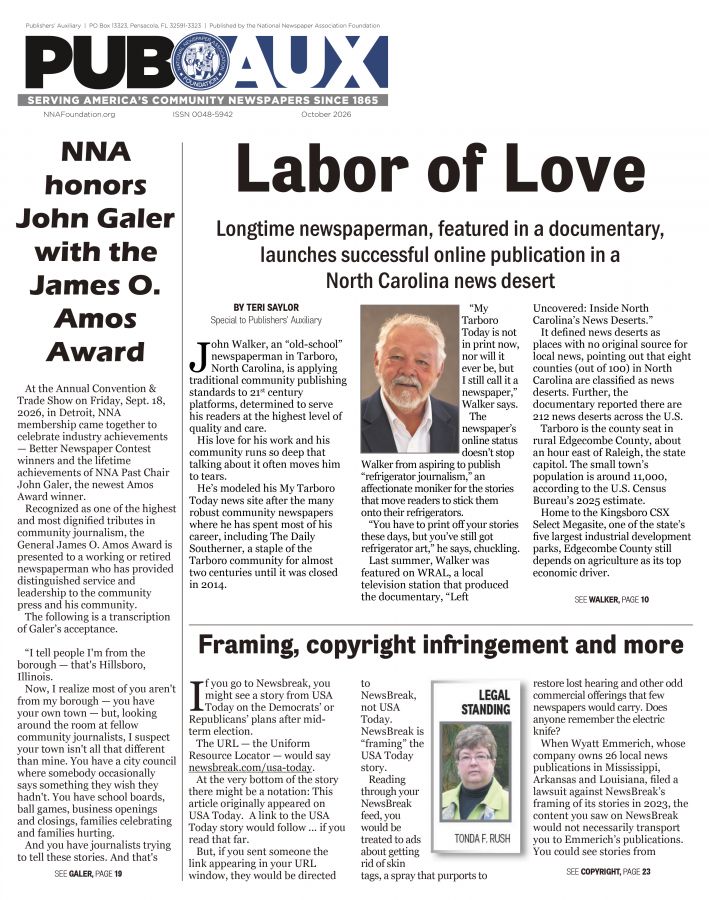
John Walker, an “old-school” newspaperman in Tarboro, North Carolina, is applying traditional community publishing standards to 21st century platforms, determined to serve his readers at the highest level of quality and care.
His love for his work and his community runs so deep that talking about it often moves him to tears.
He’s modeled his My Tarboro Today news site after the many robust community newspapers where he has spent most of his career, including The Daily Southerner, a staple of the Tarboro community for almost two centuries until it was closed in 2014.
“My Tarboro Today is not in print now, nor will it ever be, but I still call it a newspaper,” Walker says.
The newspaper’s online status doesn’t stop Walker from aspiring to publish “refrigerator journalism,” an affectionate moniker for the stories that move readers to stick them onto their refrigerators.
“You have to print off your stories these days, but you’ve still got refrigerator art,” he says, chuckling.
Last summer, Walker was featured on WRAL, a local television station that produced the documentary, “Left Uncovered: Inside North Carolina’s News Deserts.”
It defined news deserts as places with no original source for local news, pointing out that eight counties (out of 100) in North Carolina are classified as news deserts. Further, the documentary reported there are 212 news deserts across the U.S.
Tarboro is the county seat in rural Edgecombe County, about an hour east of Raleigh, the state capitol. The small town’s population is around 11,000, according to the U.S. Census Bureau’s 2025 estimate.
Home to the Kingsboro CSX Select Megasite, one of the state’s five largest industrial development parks, Edgecombe County still depends on agriculture as its top economic driver.
The documentary portrays Walker’s role as “one man trying to do the job a whole paper once did before corporate ownership closed The Daily Southerner.” He was the newspaper’s publisher when it shuttered.
Following the newspaper’s closure, Walker says he and his wife, Stephanie, relocated to the New Orleans area, and he became editor of the 152-year-old St. Tammany Farmer.
After Stephanie was diagnosed with breast cancer, the couple returned to Tarboro, where they still had a home and where she could receive treatment through Duke Cancer Center. Walker wrote for Welcome to Tarboro magazine and the Rocky Mount Telegram before launching My Tarboro Today. He still writes for the magazine.
Walker describes My Tarboro Today as “live, local news.”
In the documentary, he is emotional before the cameras when he describes how readers in Tarboro have received his publication.
“The community’s been good to us,” he says, his voice breaking. “And even though a corporate owner gave up on it, I’m not going to.”
Walker, who grew up in Mississippi, spent most of his career working at newspapers across the south. He arrived in Tarboro in 2012 by way of Community Newspaper Holdings, Inc. (CNHI), which owned The Daily Southerner, one of the oldest newspapers in North Carolina. Tracing its origins back to 1826 as the Tarborough Free Press, this year would have marked its 200th anniversary, according to the Encyclopedia of North Carolina.
In 1852, the name changed to The Tarboro Daily Southerner and later was shortened to The Daily Southerner. The Creech family was its last local owner, selling it to American Publishing Company in 1991, with Jerome Creech serving as publisher until 2001.
CNHI purchased The Daily Southerner in 2000 and closed it in 2014.
Walker started his newspaper career in high school. A football injury forced him to convert from a player on the field to a statistician on the sidelines. Hunting and pecking out statistics on his mother’s old Remington typewriter, he discovered he also had the soul of a newsman and began selling football stories to local newspapers as sports stories.
“I covered games for four or five newspapers, and about a month after starting, I got some envelopes in the mail, and they contained checks for the games I had called in,” he says.
While $2 a game doesn’t sound like much, they added up and were enough to make a high school kid feel important, and they kindled a flame inside him to pursue a career in newspapers.
He was still in high school covering sports and writing obituaries at the Delta Democrat Times in Greenville, Mississippi, when he was summoned to the office of none other than the publisher, the late, great Hodding Carter II.
He considers the experience his first reality check.
It all started with a little note from Carter, rolled up in his typewriter, requesting a meeting.
“I remember his office as being narrow and long and dark,” Walker says, demonstrating the dimensions of the office with his hands. “There was one of those little green lampshade lamps on his desk.”
After a few minutes of light conversation, Carter informed the aspiring journalist that he had misspelled someone’s name in an obituary. Walker admitted he neglected to check the spelling, claiming he just knew it.
“Mr. Carter’s hand came down and hit that desk so hard it scared the heck out of me,” Walker recalls. “He says, ‘well, you knew it wrong.’”
Carter gave Walker the first of many lessons he would learn in his journalism career — to always verify the spelling of names.
"There are two times someone gets their name in the Delta Democrat Times,” Carter told Walker. “When they're born and when they die, unless they're arrested, and we will damn well get it correct. Do you understand?"
After 60 years, Walker, now 76, still understands.
Walker’s dad was a farmer. His mother’s uncle and a half-brother had worked at newspapers in New York and South Carolina. He can’t credit them for influencing his own newspaper career because he never knew them. But his father was an avid newspaper reader.
He recalls going into town with his dad during the summertime when he wasn’t in school and buying the (Jackson) Clarion-Ledger and the (Memphis) Commercial Appeal.
“We would go back to the farm and sit in the field, and he would read the newspapers,” Walker says. “And when he finished, he'd hand them to me, and I'd read them and ask him questions. It was a living classroom.”
Walker went on to earn a degree in English from Delta State University where he also worked on the university newspaper and in the sports publicity office.
From there, he launched his long, winding career, and when the time comes, he’ll end on a high note as publisher and owner of My Tarboro Today, now the only news organization covering his town.
Across his career, he’s won dozens of awards and judged too many journalism contests to count.
As general manager and managing editor of The Daily News, a Wick Communications newspaper in Bogalusa, Louisiana, he arrived a week before Hurricane Katrina hit and led his team’s storm coverage and its aftermath, using generators for more than three weeks to produce the newspaper.
He received the Louisiana Press Association’s Gibbs Adams Award for Best Investigative Reporting.
He’s experienced the highs of landing fresh opportunities to publish highly regarded newspapers and the lows that come with the sales and cutbacks by corporate entities.
While in Bogalusa, Walker launched his first online newspaper and called it My WP News, covering Washington Parish. At that time, he had no way of knowing it foreshadowed My Tarboro Today, which he launched it in 2023.
He says his news operation is 24/7 and uses the Texas-based software platform Bulletlink to post stories on a rolling basis. He offers subscriptions but doesn’t charge for them, so there’s no paywall. He uses Facebook to amplify the stories and send readers to his website.
Thanks to the internet, “local” news can be published from almost any location. Gone are the days when it was essential for newspaper leaders to live in the communities they covered, although many of them hold firm to the notion that a local newspaper must be local through and through.
Walker feels that way, too, and along with publishing local news, he believes in being involved in his community. During a management stint at the Thomasville Times in North Carolina, a furniture company shut down two weeks before Christmas, leaving 600 people unemployed.
Walker’s team created the Thomasville Times Employee Food Challenge and asked its 40 employees to donate to the cause.
“We started out collecting 400 food items and offered opportunities for local businesses to donate in exchange for running their photos in the newspaper,” he says. “With that, we collected 27,000 food items.”
Today, Walker is looking for ways to give back to Tarboro.
“Being a community newspaper means helping your community in many ways,” he says. “And that’s what I’m trying to do here with My Tarboro Today.”
While judging a newspaper contest, he learned about a youth wrestling tournament staged in a small Nebraska town and he suggested a similar tournament in Tarboro this fall. He’ll be there to cover it.
“It's called Main Street Mayhem,” he says. “We're going to have six mats in the middle of the street downtown, and we're expecting around 300 wrestlers and 1,500 or so fans.”
My Tarboro Today is a for-profit operation, but readers often make donations to show their appreciation for Walker’s work. He has several regular advertisers and began publishing public notices after the county clerk of superior court qualified My Tarboro Today to accept them.
Walker’s emotions bubble up when he discusses funding his operation.
“I hate to say it, but money has never been a priority,” he says, adding that this attitude is what sets his publication apart.
“It’s hard to say that in this day and age when costs are going up,” he says. “But money is what the hedge-fund newspaper owners want, while we’re focused on serving our community.”
He takes his government watchdog role seriously, carefully covering as many local governments in his county as possible.
Recently, he started sourcing North Carolina news through Center Square, formerly Watchdog.org, a news website and wire service that covers state and local governments.
He also takes seriously his role in publishing obituaries, which he runs for free, including headshots.
“I have never charged a cent for an obituary,” he says. “Families don’t need one more person coming up to them with their hand out, and until the day I die, I’m not going to charge for an obituary.”
The local television station that ran the documentary on news deserts is one of the state’s dominant stations, and many viewers tuned in. Afterward, Walker’s subscriptions soared, along with his page views and social media engagement.
He now has more than 3,500 free subscribers.
Before the documentary aired three months ago, he had logged about four million unique page visits across the life of My Tarboro Today, and in the three months since the documentary aired, those numbers have swelled to over 7.5 million.
“Not in my wildest dreams did I ever expect that to happen,” he says. “It's been a humbling experience.”
To this day, Walker still employs the hunt and peck method of composing stories, using a laptop keyboard instead of the stiff typewriter keys from days gone by.
But he has never let go of his trusty old Remington.
“It’s in storage now,” he says. “Through all my moves around the country, it’s gotten beat up, but it’s still with me.”
That old typewriter is a reminder of where he started and how far he has come, and at the end of the day, one fact remains about his long career.
“It’s an absolute labor of love,” he says.
Teri Saylor is a freelance writer in Raleigh, North Carolina. Reach her at terisaylor@hotmail.com. To watch the WRAL documentary on news deserts in North Carolina, visit https://bit.ly/4xRCjNt Check out My Tarboro Today at https://mytarborotoday.com/